

 May 25, 2026
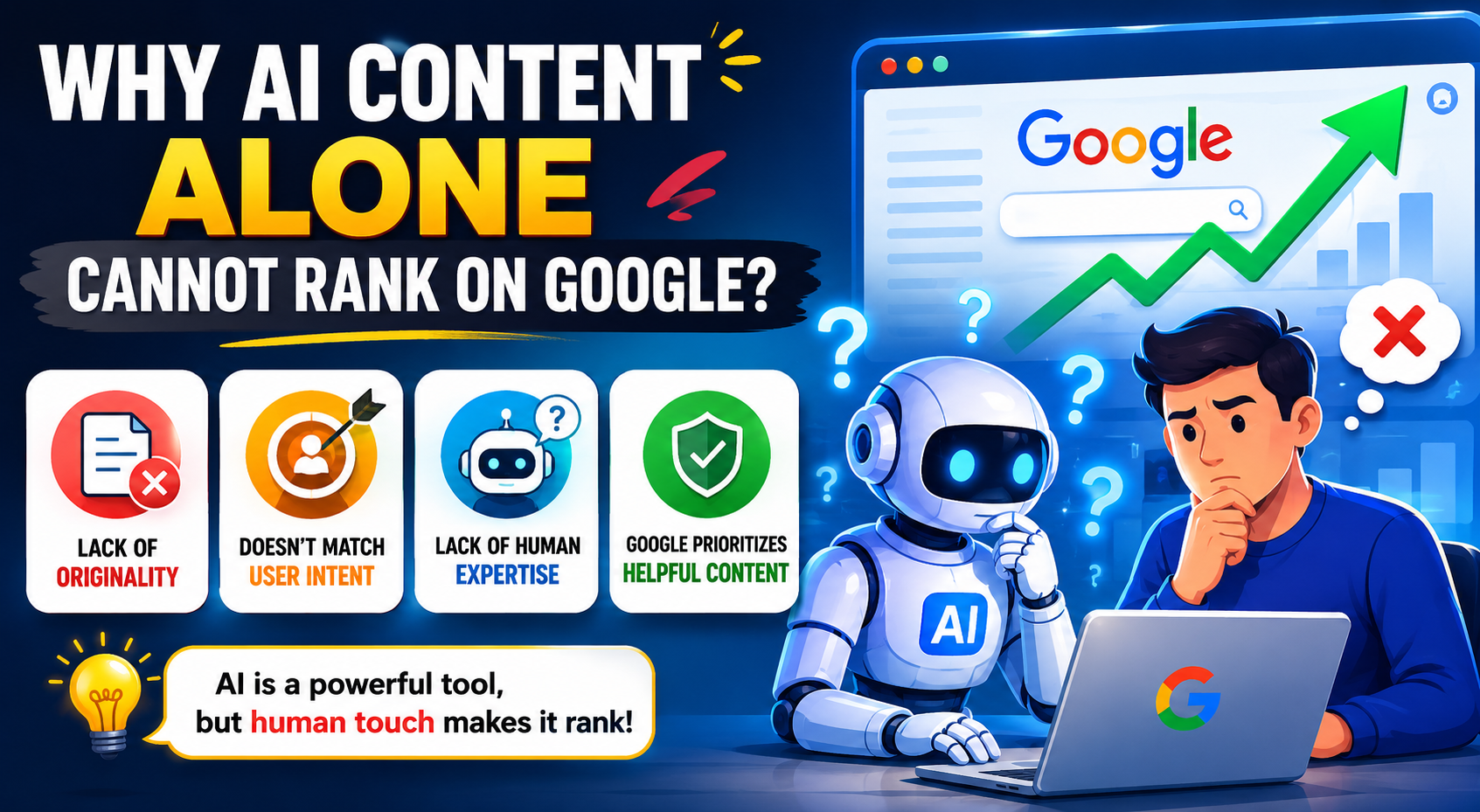
Why AI Content Alone Cannot Rank on Google in 2026
Introduction
Artificial Intelligence has completely transformed digital marketing and content creation. Today, businesses use AI tools to generate blog posts, website pages, social media captions, product descriptions, email campaigns, and even video scripts within minutes. AI writing tools save time, reduce costs, and increase productivity. Because of these advantages, many companies started believing that publishing fully AI-generated content is enough to rank on Google.
However, reality is very different.
Many websites that rely only on AI-generated content struggle to achieve rankings, traffic, engagement, and conversions. Some pages get indexed but never reach the first page of Google. Others lose rankings after updates. In some cases, entire websites experience traffic drops because their content lacks originality, expertise, and real value.
Google’s algorithms have become smarter in 2026. Search engines now focus heavily on content quality, user experience, helpfulness, expertise, trustworthiness, and originality. Simply generating thousands of AI-written words is no longer an effective SEO strategy.
AI can assist content creation, but AI alone cannot guarantee rankings.
Businesses that combine AI efficiency with human creativity, SEO strategy, research, and expertise achieve much better results than those depending only on automated content.
In this blog, we will explore why AI content alone cannot rank on Google, the biggest limitations of AI-generated content, how Google evaluates quality, and how businesses can use AI correctly for SEO success in 2026.
Understanding AI-Generated Content
What Is AI Content?
AI-generated content refers to articles, blogs, website copy, or marketing text created using artificial intelligence tools. These tools analyze huge amounts of data and generate human-like text based on prompts given by users.
Popular AI writing tools can create:
- Blog articles
- Website pages
- Product descriptions
- Social media content
- Email marketing copy
- Video scripts
- SEO articles
- Ad copy
- Landing page content
AI tools are excellent for improving speed and productivity. Instead of writing from scratch, marketers can generate drafts within seconds.
But there is a major difference between generating content and creating high-quality ranking content.
Google does not reward content simply because it exists. Google rewards content that helps users better than competitors.
That is where AI-only content often fails.
How Google Evaluates Content Quality
Google Prioritizes Helpful Content
Google’s ranking system is designed to show the most useful and trustworthy content to users.
The search engine evaluates:
- Relevance
- Originality
- User experience
- Expertise
- Trustworthiness
- Accuracy
- Depth of information
- Engagement
- Content usefulness
This means content must genuinely solve user problems.
Many AI-generated articles are generic because AI tools predict text patterns instead of providing real-world expertise and experiences.
That creates a problem for rankings.
Understanding EEAT
Google strongly focuses on EEAT:
Experience
Real-life experience with the topic.
Expertise
Knowledge and authority in a subject.
Authoritativeness
Industry reputation and credibility.
Trustworthiness
Reliable and accurate information.
AI cannot truly provide personal experience or genuine expertise.
For example:
A travel blogger sharing personal experiences in a destination offers more value than an AI-generated travel article created from internet summaries.
Similarly, a doctor writing healthcare advice carries more authority than generic AI health content.
This is one of the biggest reasons AI content alone struggles to rank.
Major Reasons Why AI Content Alone Cannot Rank
AI Content Often Lacks Originality
One of the biggest problems with AI-generated content is repetition.
AI tools learn from existing online information. They predict common language patterns and generate content accordingly. As a result, many AI-written articles sound similar.
Google values unique insights and fresh perspectives.
If your content looks like hundreds of other articles online, there is little reason for Google to rank it higher.
Common originality problems in AI content:
- Repetitive sentences
- Generic explanations
- Similar blog structures
- Predictable wording
- Lack of unique opinions
- No personal experiences
- No industry-specific insights
Originality is essential for SEO success in 2026.
AI Cannot Understand User Intent Deeply
Google focuses heavily on search intent.
Search intent means understanding what users actually want when they type a query.
For example:
A user searching “best SEO strategies for local businesses” may want:
- Practical tips
- Local SEO examples
- Step-by-step guidance
- Real case studies
- Updated strategies
AI tools may create broad information but often fail to fully match user expectations.
Human writers understand emotions, audience behavior, pain points, and industry trends much better than AI.
That human understanding improves rankings significantly.
AI Content Often Contains Inaccuracies
AI Can Generate Incorrect Information
AI tools sometimes create false or outdated information.
This is called AI hallucination.
The AI may confidently provide:
- Incorrect facts
- Fake statistics
- Wrong dates
- Inaccurate explanations
- Misleading SEO advice
Google prioritizes accurate information because user trust matters.
If your website repeatedly publishes inaccurate content, rankings can suffer.
This is especially risky in industries like:
- Healthcare
- Finance
- Legal services
- Education
- Technology
- News
Human verification is essential before publishing AI-generated content.
Thin Content Is a Major SEO Problem
Many AI Articles Lack Depth
AI-generated blogs often provide surface-level information without deep analysis.
Google prefers comprehensive content that fully answers user queries.
Thin AI content usually:
- Repeats basic information
- Lacks examples
- Avoids detailed explanations
- Contains filler text
- Misses expert insights
For competitive keywords, shallow content rarely ranks well.
High-ranking pages typically include:
- Detailed explanations
- Expert analysis
- Visual examples
- Case studies
- Real-world data
- Actionable strategies
AI alone usually cannot create that level of value.
AI Cannot Replace Human Creativity
Creativity Improves User Engagement
Human creativity plays a huge role in successful content marketing.
Creative writing includes:
- Storytelling
- Emotional connection
- Humor
- Brand voice
- Persuasive messaging
- Unique examples
- Audience psychology
AI-generated content often sounds robotic or emotionally flat.
Even advanced AI struggles to fully understand human emotions and cultural context.
Users engage more with content that feels authentic and relatable.
Higher engagement leads to:
- Longer session duration
- Lower bounce rates
- More shares
- Better conversions
- Improved SEO signals
Human creativity remains essential.
Google Detects Low-Quality Automated Content
Spam Policies Are Stricter in 2026
Google does not ban AI content simply because it is AI-generated.
However, Google strongly penalizes low-quality automated content created mainly to manipulate rankings.
Examples include:
- Mass-produced articles
- Keyword-stuffed AI pages
- Auto-generated spam blogs
- Duplicate AI content
- Unhelpful SEO articles
Google’s spam systems have become more advanced.
Websites publishing large amounts of low-value AI content often experience:
- Ranking drops
- Reduced indexing
- Traffic loss
- Manual penalties
Quality matters more than the method of creation.
Human Editing Is Essential for SEO Success
Why Human Editing Matters
Human editors improve AI-generated drafts by adding:
- Accuracy
- Clarity
- SEO optimization
- Brand voice
- Personal insights
- Readability
- Real examples
- User-focused structure
Without editing, AI content usually lacks depth and authority.
Professional SEO content teams combine AI efficiency with human expertise for better performance.
This hybrid approach produces stronger rankings.
AI Cannot Build Brand Authority Alone
Authority Requires Trust
Strong brands build trust through:
- Industry expertise
- Real experiences
- Original research
- Thought leadership
- Case studies
- Customer success stories
AI tools cannot independently create authentic authority.
Businesses need real human expertise behind their content.
Google rewards websites that demonstrate genuine industry knowledge and credibility.
That is why expert-written content consistently performs better than fully automated blogs.
User Experience Impacts Rankings
SEO Is More Than Just Content
Google also evaluates overall user experience.
Even excellent content may struggle if the website has:
- Slow loading speed
- Poor mobile design
- Too many ads
- Weak navigation
- Bad readability
- Low engagement
AI tools do not optimize complete user experience strategies.
Successful SEO requires:
- Technical SEO
- Content strategy
- UX optimization
- Internal linking
- Page speed improvements
- Mobile responsiveness
AI content alone cannot handle all these ranking factors.
Search Engines Prefer Real Value
Helpful Content Wins
Google’s Helpful Content System focuses on rewarding genuinely useful content.
The search engine asks:
- Does the content help users?
- Does it answer questions clearly?
- Is it created for people instead of search engines?
- Does it provide original value?
Many AI-only articles are written mainly for ranking purposes rather than helping users.
That approach no longer works effectively.
Websites that prioritize user satisfaction achieve better long-term SEO results.
Why Human Expertise Still Matters
Experts Provide Deeper Insights
Industry experts understand:
- Real customer problems
- Market trends
- Professional experiences
- Practical solutions
- Advanced strategies
AI tools generate information based on patterns, not actual understanding.
Human experts provide unique perspectives that AI cannot replicate.
For example:
An experienced SEO professional can share:
- Real campaign results
- Client case studies
- Ranking experiments
- Industry predictions
- Strategic advice
That type of expertise improves content quality significantly.
AI Content and Duplicate Content Risks
Similar AI Outputs Create Competition Problems
Many businesses use the same AI tools.
When users enter similar prompts, AI often generates similar content structures and wording.
This creates:
- Content duplication risks
- Lack of uniqueness
- Reduced differentiation
- Lower competitive advantage
Google prefers websites that offer something different and valuable.
Unique content performs much better than repetitive AI articles.
The Importance of Content Strategy
SEO Requires Planning
Publishing random AI-generated blogs is not an effective SEO strategy.
Successful SEO requires:
- Keyword research
- Competitor analysis
- Search intent optimization
- Content clustering
- Internal linking
- Topic authority building
- Conversion optimization
AI tools assist with writing but cannot fully replace strategic planning.
Human SEO specialists are still necessary.
AI Cannot Fully Understand Audience Emotions
Emotional Connection Increases Engagement
Humans buy products and trust brands based on emotions.
Good content connects emotionally with readers.
AI-generated content often lacks:
- Emotional depth
- Personal connection
- Authentic storytelling
- Cultural understanding
Human writers create stronger emotional engagement, which improves:
- Brand loyalty
- Sharing behavior
- Conversion rates
- User trust
This indirectly supports better SEO performance.
Case Studies and Real Experiences Matter
Real Examples Improve Credibility
Google values content supported by:
- Real-world examples
- Research
- Original data
- Case studies
- User experiences
AI tools usually cannot create authentic case studies unless humans provide the information.
Businesses that include real experiences build more trust and authority.
That improves rankings over time.
AI Works Best as an Assistant, Not a Replacement
The Best SEO Strategy in 2026
The most effective approach is combining:
AI Efficiency
For:
- Research assistance
- Content outlines
- Draft generation
- Idea brainstorming
- Productivity improvements
Human Expertise
For:
- Editing
- Strategy
- SEO optimization
- Fact-checking
- Creativity
- Brand voice
- Original insights
This combination creates high-quality content that satisfies both users and search engines.
How to Make AI Content Rank Better
Use AI Correctly
Businesses should follow these best practices:
Add Human Editing
Never publish raw AI output directly.
Include Original Insights
Add experiences, opinions, and examples.
Focus on User Intent
Understand what users actually want.
Optimize SEO Properly
Use headings, keywords, internal links, and metadata strategically.
Improve Readability
Use short paragraphs and clear formatting.
Add Real Data
Include research, statistics, and case studies.
Update Content Regularly
Keep information fresh and accurate.
Build Authority
Show expertise and trustworthiness.
The Future of AI Content and SEO
AI Will Continue Growing
AI tools will become even more advanced in the future.
However, Google’s primary goal will remain the same:
Delivering the best possible results to users.
That means quality, originality, trust, and usefulness will always matter more than automation alone.
Businesses using AI responsibly with strong human involvement will dominate search rankings.
Those depending only on automated content will continue struggling.
Conclusion
AI has changed content creation forever. It helps businesses produce content faster, reduce costs, and improve productivity. But AI-generated content alone is not enough to rank successfully on Google in 2026.
Google now prioritizes:
- Helpful content
- Original insights
- Human expertise
- User experience
- Accuracy
- Trustworthiness
- Real value
AI tools cannot fully replace human creativity, strategy, expertise, and emotional understanding.
The best SEO results come from combining AI technology with human intelligence.
Businesses that use AI as a support tool instead of a complete replacement create stronger content, better user experiences, higher trust, and improved search rankings.
In the future, successful digital marketing will not be about choosing between AI and humans. It will be about using both together intelligently.
FAQs
Can AI-generated content rank on Google?
Yes, AI-generated content can rank on Google if it is high-quality, original, helpful, and properly optimized. However, content created entirely by AI without human editing often struggles to perform well.
Why does Google not rank AI content easily?
Google prioritizes useful, trustworthy, and people-first content. Many AI-generated articles lack originality, real experience, emotional connection, and expert insights, which affects rankings.
Does Google penalize AI-written content?
Google does not directly penalize AI-written content. It only penalizes low-quality, spammy, or unhelpful content created mainly to manipulate search rankings.
What are the biggest problems with AI-generated content?
Common issues include:
-
Lack of originality
-
Thin content
-
Incorrect information
-
Weak user intent understanding
-
No real-life expertise or experience
How can businesses improve AI-generated content for SEO?
Businesses should:
-
Add human editing
-
Include original insights
-
Optimize for search intent
-
Add case studies and examples
-
Improve readability and user experience
What is EEAT in SEO?
EEAT stands for:
-
Experience
-
Expertise
-
Authoritativeness
-
Trustworthiness
Google uses EEAT to evaluate content quality and credibility.
Is AI content better than human-written content?
AI content is faster and more efficient for drafting, but human-written content is usually better for creativity, emotional connection, expertise, and building trust with users and search engines.
 (123) 334 456 7890
 our blog

 Digro Admin
 July 18, 2026